
Freedom Deferred: The Political Failure of Kashmir’s Self-Determination: By Salman Khan.

Introduction
The Kashmir dispute has shaped the geopolitical relationship between India and Pakistan since their emergence as independent states in 1947. It also intersects with broader regional tensions, including the Sino-Indian dispute over Aksai Chin. Strategically located between three nuclear-armed and populous states—India, Pakistan, and China—Kashmir spans approximately 80,000 square kilometres and is home to over 17 million people (including diaspora).
As one of the longest unresolved conflicts of the modern era, Kashmir has been marked by territorial division, militarisation, and recurring cycles of violence. Since the entry of Indian forces into the region on 27 October 1947, the former princely state of Jammu and Kashmir has remained divided along the Line of Control (LoC), separating areas administered by India and Pakistan. Despite multiple wars (1948, 1965, 1971), near-war crises such as the 1999 Kargil conflict, and decades of diplomatic engagement, a mutually acceptable resolution has remained elusive.
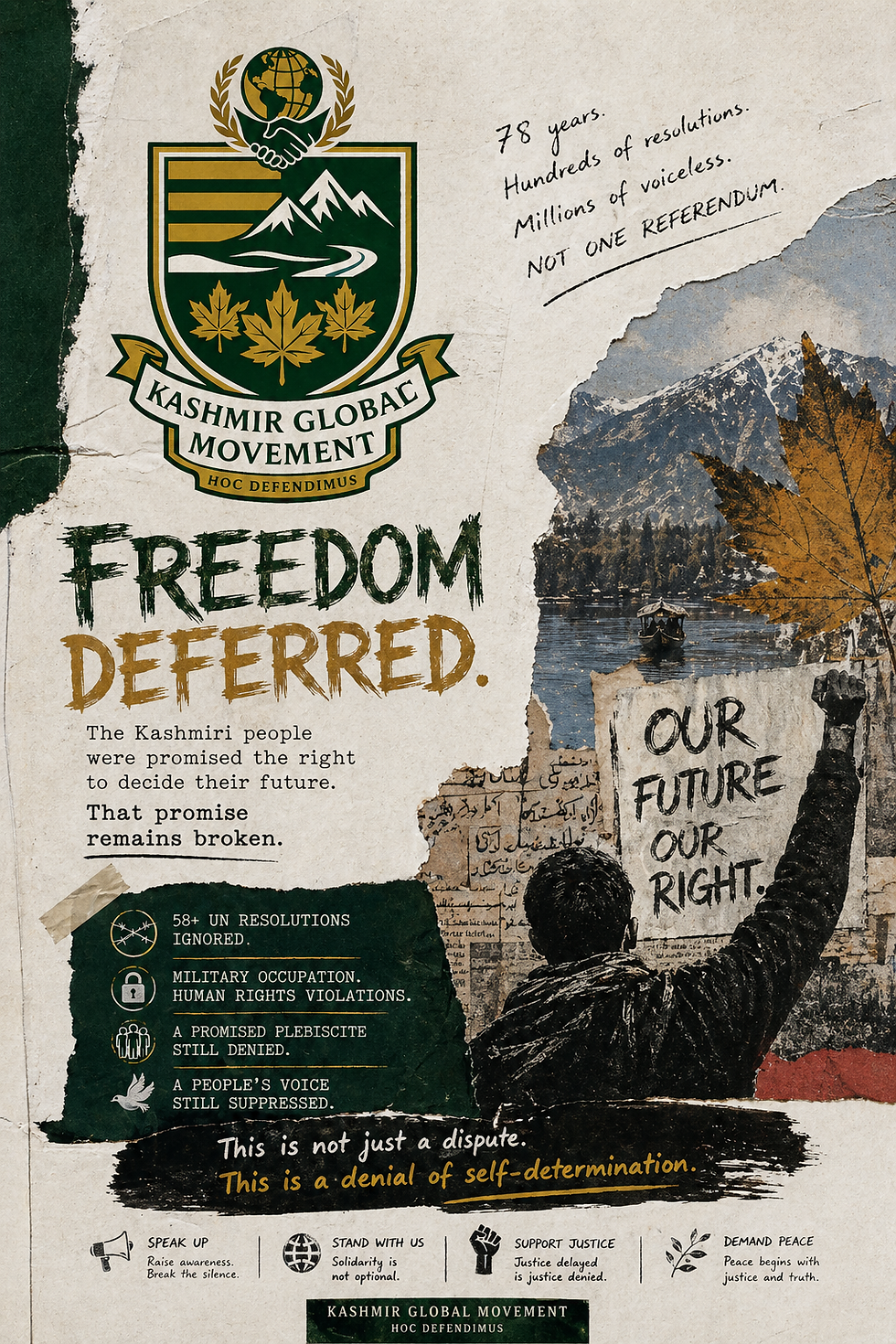
Central to the dispute is the question of self-determination. This principle, embedded in international law and affirmed in early United Nations Security Council resolutions—particularly United Nations Security Council Resolution 47—called for a free and impartial plebiscite to determine the political future of the region. Yet, more than seven decades later, this commitment remains unfulfilled.
The persistence of the conflict reflects not only bilateral tensions between India and Pakistan, but also systemic limitations within international institutions, shifting geopolitical priorities, and internal fragmentation among stakeholders. The revocation of Articles 370 and 35A in August 2019 further intensified the dispute, raising new concerns about demographic transformation and the erosion of regional autonomy.
This study argues that the Kashmir conflict represents a case of “freedom deferred”—a prolonged denial of self-determination shaped by the failures of state actors, the inertia of global powers, and the fragmented agency of non-state actors. It situates Kashmir within a comparative framework of other self-determination struggles, including East Timor and South Sudan, to interrogate why similar outcomes have not materialised in Kashmir.
Core Argument
1. Failure of State Actors
India
Prioritised territorial sovereignty over negotiated settlement uses state terrorism
Gradual erosion of autonomy culminating in 2019 constitutional changes as unilaterly revokes the Article 370 35a
Reframing Kashmir from an international dispute to an internal matter
Pakistan
Internationalised the issue but inconsistently
Reliance on diplomatic rhetoric without sustained strategic leverage
Internal political instability weakening long-term policy consistency
Critical insight: Both states instrumentalise Kashmir—less as a humanitarian issue, more as a geopolitical asset.
2. Failure of the United Nations & Global Powers
United Nations
Early activism (1948–1950) → long-term paralysis
Resolutions without enforcement mechanisms
Peacekeeping without political resolution (UNMOGIP as symbolic presence)
Global Powers
Cold War politics sidelined Kashmir
Post-9/11: strategic alignment with India as economic and security partner
Selective application of self-determination principles
Compare with:
East Timor
Strong international intervention → 1999 referendum → independence
South Sudan
Backed by sustained diplomatic and institutional pressure
Key contrast:Kashmir lacks great-power consensus, which was decisive in both cases.
3. Non-State Actors and Fragmentation
Armed groups: delegitimised the movement internationally
Civil resistance: often overshadowed by militarised narratives
Human rights organisations: raised awareness but limited enforcement impact
Insight: The narrative of Kashmir has been securitised, not humanised.
4. Critical Analysis: The Kashmir Diaspora
The Kashmiri diaspora represents a paradox within the struggle for self-determination. While positioned in liberal democratic societies with access to political platforms, media, and resources, segments of the diaspora have struggled to translate this privilege into sustained, strategic advocacy.
Activism is often episodic—peaking during commemorative events and crises—rather than institutionalised or policy-driven. Internal divisions, leadership rivalries, and a tendency toward symbolic rather than structural engagement have limited impact. The narcissism in diaspora is core evil amidst of tragedy Kashmir.
In some cases, diaspora discourse is characterised by externalisation of responsibility—primarily toward Pakistan—while underutilising their own positional leverage within Western political systems. This has contributed to a performative cycle of visibility without tangible policy outcomes.
5. Why “Freedom Deferred”?
Because Kashmir sits at the intersection of:
Nuclear deterrence (too risky to resolve forcefully)
Strategic economics (India’s global importance)
Institutional weakness (UN limitations and its ambiguous role in resolving international conflicts)
Fragmented advocacy and disunity among Kashmir dispora (internal + diaspora)
In simple terms:It is not ignored—it is conveniently unresolved.
6. Comparative Lens: Why Not Kashmir?
Case | Outcome | Why Successful |
East Timor | Independence (2002) | Strong UN mandate + Western backing |
South Sudan | Independence (2011) | Sustained US & AU pressure |
Kashmir | Unresolved | Geopolitical cost too high |
Conclusion insight:Self-determination is not a right universally applied—it is a right selectively enforced.
Conclusion
The Kashmir conflict endures not due to lack of legal frameworks or historical clarity, but due to the convergence of political interests that favour its indefinite postponement. The failure of state actors, the inconsistency of international institutions, and the fragmented agency of non-state actors have collectively transformed a promised act of self-determination into a prolonged condition of political limbo.
“Freedom Deferred” is therefore not merely a description of Kashmir’s past—it is an indictment of the global order that sustains its present and more so the fragmented and disunited Kashmir diaspora is the core to the unresolved dispute of Kashmir.
Author:
Salman I Khan. Paul Harris Fellow, T.I
Founder and Chairman
South African Kahsmiri Action Group (SAKAG)
Kashmir Center for African Union (KCAU)
Kashmir Global Movement (KGM)


Comments