
State Impunity under Hindutva Policies: Shrinking Space for Minorities in India and IIOJK. By Saba Gulam Nabi

The approach of India towards the rights of minorities and religious freedom reveals a stark contradiction. This contradiction has increasingly transformed into Hindutva-driven extremist nationalism, in line with its ideological framework after the Bhartiya Janata Party come in to power. Under this ideology, only Hindus are seen as rightful and peaceful inhabitants of India, while other minorities and even marginalized castes are systematically denied equal rights and protection in India.
Under Prime Minister Narendra Modi, policies have been aggressively intensified, leading to continuously worsened religious freedom in India through discriminatory legislation such as anti-conversion laws, cow-slaughter laws, and the misuse of anti-terrorism laws.
Across India, minority communities, Muslims, Dalits, Christians, and other marginalized groups are facing an alarming erosion of their basic rights, with Muslims bearing the brunt of this repression.

In doing so, authorities have arbitrarily detained individuals, highlighting serious violations of religious freedom. Indian officials have repeatedly used hateful and derogatory rhetoric, along with misinformation, to perpetuate false narratives about minorities inciting widespread violence, hate speech, lynchings, and the demolition of religious places.
On the eve of Christmas, members of the Christian community were beaten and prevented from celebrating their religious festival.
Journalists and scholars have openly stated that “if you are a Muslim living in India, then the law is applied to you differently and discriminately.”But if you are a Kashmiri Muslim, then the case is totally different; there is no law of justice for you. The crimes that are punishable in India are justifiably so in Kashmir. The Kashmiris have witnessed the worst-ever human rights violations in the world, and are living in the world’s highest military zone.
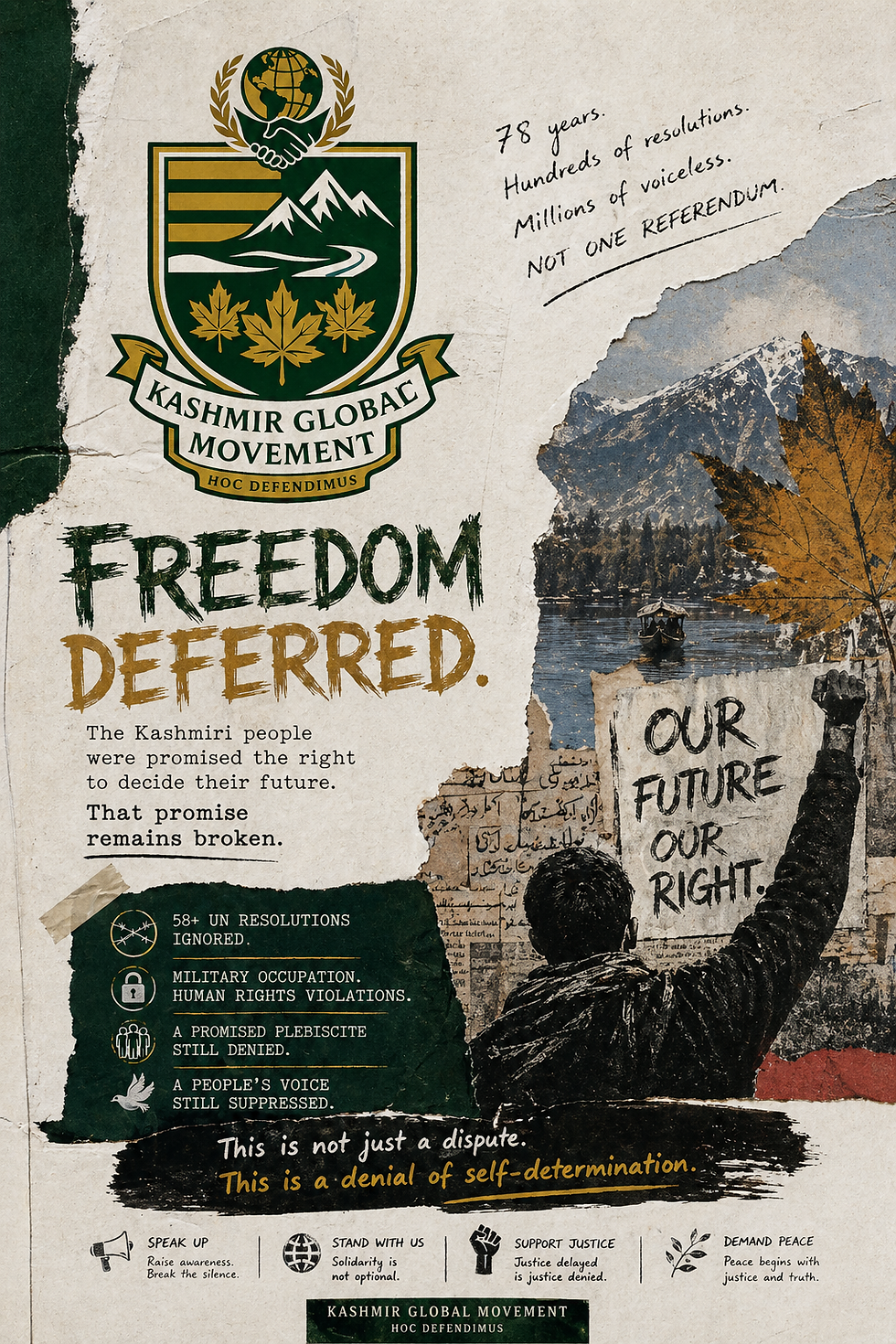
For 78 years, the people of Kashmir have lived under the illegal occupation of India that defies international laws, bilateral agreements, and moral conscience.
India has been violating international norms since its independence. The partition of the sub-continent plan was violated by India, by establishing illegal occupation over the state of Jammu and Kashmir. At the time, Jammu and Kashmir was a Muslim-majority state. To create a Hindu-dominated Jammu region, India carried out the Jammu Genocide of 1947, reducing the Muslim population from 66% to 31% and consolidating Hindu dominance. Following this, when the Kashmir dispute emerged due to India’s illegal occupation, India took the issue to the United Nations in 1948 under the pretense of seeking a resolution. The United Nations Security Council recognized the state as a disputed territory and passed a resolution for a plebiscite to determine its fate, with the wishes of the people of the state, which has been systematically violated by India ever since.
India has unilaterally breached the bilateral agreements, the Indus Water Treaty of 1960, and the Shimla agreement of 1972, showing the consistent violations of bilateral commitments and international norms.
In 2019, India unilaterally revoked the special status of the state of Jammu and Kashmir and divided it into two union territories. After the revocation of this special status, India issued 800,000 domicile certificates to non-locals, mainly Hindus, and registered more than 2.5 million new non-voters, a demographic-engineering designed to transform the Muslim majority state into a Hindu, simply to change the identity of the region. And pretending this act as an administrative reform to the world, but it as an attack on the identity of the people of Kashmir and a violation of Article 49(6) of the Geneva Convention, which categorizes these actions as “War Crimes”, and constitute a clear violation of international humanitarian law, under this provision, an occupying power is strictly prohibited from transferring its own population into the region it occupies.”
In Kashmir, the imposition of Draconian Laws, such as Unlawful Activities Prevention (UAPA), the Public Safety Act (PSA), Cordon and search operation (CASO) and the Armed Forces Special Power Act (AFSPA) under the guise of security, granting the exceptional powers to the occupying Indian forces, and has been used to suppress the population of the region against ongoing violations.
Section (6) of the AFSPA effectively protects the Indian forces from prosecution, defying Article 2(3) of the International Covenant on Civil and Political Rights (ICCPR), which states to provide effective measures against the violations of the rights.
There are routine cases of disappearance of the Kashmiris, mass detentions, torture in jails and even in public places, rape, and harassment committed by Indian armed forces, for which Kashmiris have struggled to seek justice. The provisions of these draconian laws are used as protective shields to save the forces from accountability. Even Kashmiri shawl sellers are being harassed in India because they are Kashmiri. Hindutva goons have stopped them from selling shawls. Other Muslims are also forced to chant slogans like ‘Jai Shri Ram.
Perhaps the most traumatic aspects of any conflict are gender-based violence and violence against children. The Indian troops are using Kashmiri women as war trophies, while Indian politicians and MPs are openly and bluntly targeting Muslim women with humiliating and abusive words. Number of mass rape cases like Kunan-Poshpora, Shopian, and Chhanpora, where Kashmiri women have been assaulted and rape by Indian Armed forces. The United Nations Security Council Resolution (UNSCR) 1325 and the Convention on the Elimination of all Forms of Discrimination against Women (CEDAW) emphasize the protection of women in the conflict zone.”
The acts of Indian forces towards Muslim women also violate “Article 27 of the Fourth Geneva Convention, which states protection of women from attacks on their honor.” The Indian army is using women as a weapon of war rape is punishable in India, but justifiable in Kashmir.
Kashmiri children are the innocent victims of the conflict; they are beaten, killed, tortured, and forcibly disappeared at the hands of Indian forces, from their homes to schools. Along the way, they are stopped, checked, and harassed by the Armed Forces, leaving their families uncertain about whether they are alive or dead. Living in constant fear affects their education and jeopardizes their future. “The Convention on the Rights of the Child (CRC) prohibits arbitrary detentions, torture, and harm to children in armed conflict.” But India is blatantly violating all norms by calling itself the mother of Democracy.
Here, the question arises: Does India continue to violate international norms with impunity? Will there ever be accountability for these violations? Or are international human rights merely an instrument for documentation rather than implementation?
Even though the number of times NGOs and human rights organizations like Human Rights Watch, Amnesty International, have repeatedly highlighted the human rights violations in Kashmir and the systematic abuses of the minority rights in India, such practices continue unabated. The suppressed voices of Kashmiris are not a reflection of peace, but it is the sound of the international community that has pressed pause on its own principles.
Systematic repression in the Hindutva regime is intensifying, and the situation has become alarming. There is an urgent need to implement the rights that exist only in documented form; these legal frameworks require genuine enforcement. It is the responsibility of the international community to resolve the Kashmir issue in accordance with the wishes of the Kashmiri people by granting them the right to self-determination as promised by the United Nations Security Council Resolution. The struggle of the Kashmiri people deserves dignity; their lives and their voices matter.

Saba Ghulam Nabi
Saba Ghulam Nabi is a research officer at the Center for International Strategic Studies in Pakistan-administered Kashmir. She specialises in the Kashmir conflict, politics, and human rights.


Comments